DNBSEQ-T7+ is a sequencer released by Complete Genomics in February 2026.
It is based
on DNA Nanoball Sequencing.
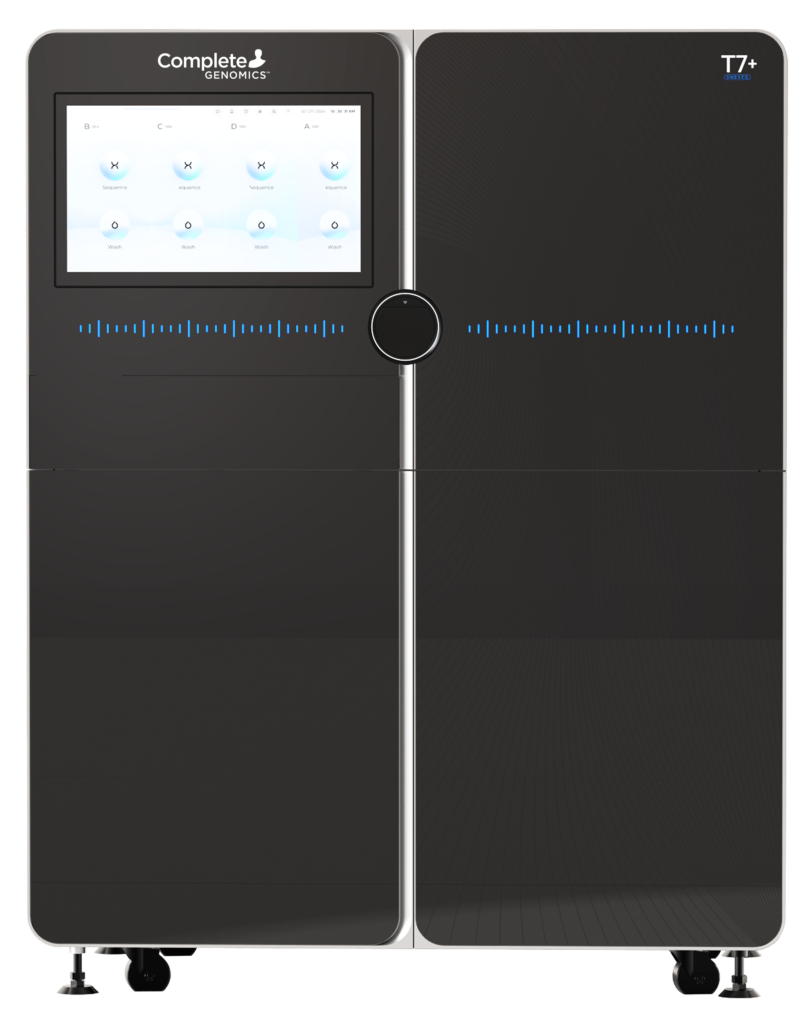
Image of DNBSEQ-T7+: https://www.completegenomics.com/products/sequencing-platforms/dnbseq-t7-plus/ by Complete Genomics
Specifications
| Manufacturer |
Complete Genomics |
| Technology |
DNA Nanoball Sequencing |
| Release date |
February 2026 |
| Price [2] |
$800,000
MSRP as of August 24, 2026
|
| Type |
Industrial |
Weight |
755 Kg |
| Supports real-time analysis |
No |
| Demultiplexing support |
Yes |
| File format |
FASTQ |
| Read length |
Complete Genomics DNBSEQ-T7+: 2x75bp to 2x150bp
|
| Run time |
Complete Genomics DNBSEQ-T7+: 14 to 24 hours
|
| Reagent cost per Gb [1] |
Complete Genomics DNBSEQ-T7+: Unavailable
|
| Data quality [3] |
Complete Genomics DNBSEQ-T7+: ≥ 90% bases above Q40
|
| Maximum output per run (Gb)[4] |
Complete Genomics DNBSEQ-T7+: 3600.00
|
| Primary error type [5] |
Indels |
Notes about the specifications
More about the Complete Genomics DNBSEQ-T7+
The DNBSEQ-T7+ is a short-read, high-throughput sequencer from Complete Genomics, the US arm of MGI Tech. MGI announced it in September 2025, and Complete Genomics announced US and Canadian availability at AGBT 2026. It targets the production-scale segment of the market: population genomics programs, large research consortia, and sequencing service providers. In these settings, cost per gigabase and throughput per day matter more than flexibility for small projects.
The T7+ is the direct successor to the DNBSEQ-T7, which MGI positioned at roughly 6 Tb per day. MGI states that the T7+ doubles daily output to more than 14 Tb, with a smaller footprint, a faster camera system, and tighter automation. Within the DNBSEQ line it sits above the DNBSEQ-T1+ (about 55 Gb to 1.2 Tb per run) and the DNBSEQ-G99 (about 8 to 240 Gb per run), which cover mid- and low-throughput work.
Key Innovations
Roughly doubled daily output: The T7+ runs up to four flow cells, each with about 12 billion reads. That gives about 48 billion reads per 24 hours. At PE150 this is roughly 3.6 Tb per flow cell and about 14.4 Tb for four. The T7 can produce up to about 24 billion reads per run.
Faster imaging with a TDI camera: MGI says time-delay integration (TDI) imaging cuts scan time by about 50%. A TDI sensor accumulates signal over several successive exposures as the flow cell moves past it. This allows faster scanning with adequate signal, and it is the main reason PE150 can finish within 24 hours despite the higher read density.
Independent flow cells: Each of the four flow cells can be started on its own schedule. A lab can run one flow cell for a small project without waiting to batch samples. A single flow cell failure also does not take down the whole run, which is useful for operational redundancy in high-volume facilities.
Integrated workflow: MGI describes a “7-in-1” design that combines DNB preparation and loading, sequencing, water and waste management, FASTQ generation, analysis, and data compression. Checkpoint-resume is supported for interrupted runs. The 24-hour figure includes DNB synthesis through base-call (.cal) file generation and the automated wash. It excludes data transfer, which at this scale can take substantial time.
High-quality-score output: The vendor claims more than 90% of bases at Q40 or above (an error rate of 1 in 10,000 or better), validated in beta testing. This is a stricter threshold than the Q30 metric most platforms claim.
Features and Technologies
DNA nanoball (DNB) chemistry: Libraries are single-stranded circular DNA. These are amplified by rolling circle replication into DNBs, concatemers of the same insert repeated many times. DNBs are loaded onto a patterned flow cell, where each binding site holds one DNB. Because amplification is linear (the original circle is always the template) rather than exponential, copy errors do not propagate through the clone population as they do in PCR-based cluster generation. Patterned arrays also fix the positions of the sequencing features, which keeps duplicate rates low and base-calling simple. The tradeoff is that DNB loading efficiency and the library circularization step add a distinctive step to library prep.
Sequencing chemistry: DNBSEQ platforms use combinatorial probe-anchor synthesis (cPAS), with fluorescent probes read out by imaging. The T7+ is described as using MGI’s SM2.0 biochemistry. The improved Q40 performance is due to the chemistry, fluidics, and optics together.
Run configurations: Supported formats are generally PE100 and PE150, with mixed PE100 and PE150 available by sequencing on different flow cells simultaneously. Run time is 20 to 24 hours. The practical read length ceiling is shorter than on long-read platforms and shorter than the PE300 available on some smaller DNBSEQ instruments.
Data quality metrics:
- Q40: greater than 90% of bases
- Output: 2.4 to 14.4 Tb depending on flow cells and read length
- Reads per flow cell: about 12 billion (48 billion for four)
- Run time: 20 to 24 hours
Reduced consumables burden: More than 90% of transport links and certain reagents do not require cold storage, which lowers energy use and cold-chain handling.
Compute: Complete Genomics offers accelerated secondary analysis hardware (MegaBolt) and compression software for the DNBSEQ-T7+. Output file volume is large: a full four-flow-cell run produces tens of terabytes of raw data, so your lab’s storage and network plans matter as much as the sequencer.
Intended Uses and Specific Applications
The platform is positioned for:
- Whole-genome sequencing (WGS): About 112 genomes per four-flow-cell run can be sequenced and up to 35,000 per year, at roughly $100 per genome and $1/Gb. Suitable library kits include the MGIEasy PCR-Free DNA Library Prep Set, the MGIEasy FS DNA Library Prep Set, and the MGIEasy Fast FS DNA Library Prep Set.
- Exome and targeted panels: The platform supports exome and targeted sequencing using MGIEasy Exome Capture kits together with MGIEasy library prep sets, including cancer panels.
- Bulk RNA-seq and transcriptomics: The platform supports bulk transcriptome sequencing using the MGIEasy RNA Directional Library Prep Set or the MGIEasy Fast RNA library prep options. About 1,920 RNA-seq samples can be sequenced per run.
- Single-cell RNA-seq: The platform supports single-cell transcriptomics using DNBelab C Series single-cell kits. About 80 single-cell RNA-seq samples can be sequenced per run.
- Spatial omics: The platform supports spatial transcriptomics using Stereo-seq (STOmics) products.
- Methylation and epigenomics: The platform supports whole-genome bisulfite and enzymatic methylation workflows. These workflows use MGI-compatible library prep kits.
- Metagenomics and large cohort studies: The platform can sequence metagenomic and large-cohort samples using standard FS or PCR-free library preparation.
- Illumina library conversion: The MGIEasy Universal Library Conversion Kit allows existing Illumina-adapter libraries to be converted for DNBSEQ sequencing. This approach is useful for piloting the platform with libraries already made for Illumina sequencing, although it adds an extra step to the workflow.
Kit names and availability differ by region and by Complete Genomics versus MGI branding. Confirm current catalog numbers with your regional supplier.
Comparison with Competing Instruments
- DNBSEQ-T7: This is the DNBSEQ-T7+’s predecessor. It delivers roughly 6 Tb per day (up to about 24 billion reads per run) with four independent flow cells, versus more than 14 Tb and 48 billion reads on the T7+. The T7+ adds the faster TDI camera, a smaller footprint, a higher claimed share of Q40 bases, and tighter integration. For new purchases at production scale the T7+ is the more sensible choice, but existing T7 installations remain productive and use compatible kits. Used or discounted T7 units could be appropriate for labs with moderate throughput needs.
- Illumina NovaSeq X Plus (25B flow cell): One 25B flow cell yields up to about 8 Tb at 2x150 bp (roughly 26 billion clusters, 52 billion reads), and a dual flow cell run reaches about 16 Tb in roughly two days. That is similar to or slightly above the T7+ per run, but over a longer run time, so daily throughput per instrument is lower than the T7+. Illumina specifies at least 85% of bases at Q30 for 2x150. Illumina’s per-base accuracy at Q30 is well established, and the platform supports read lengths up to 2x150 bp on this flow cell, with broad application validation, a large user base, and the widest software and kit ecosystem. Reagent cost is the main tradeoff. Reported pricing puts the NovaSeq X 25B at roughly $2/Gb at list, or around $200 per genome, versus the T7+’s claimed $1/Gb. Instrument list price is also higher, with a figure of roughly $1.25 million commonly cited, versus $800,000 for the T7+ in the U.S. Illumina’s flow cells are run as one or two units, so there is less scheduling flexibility than the T7+’s four independent flow cells.
Special Considerations
- Cost at scale versus utilization: The claimed $1/Gb depends on filling the flow cells. The vendor itself notes that the price depends on sample numbers. Low-volume labs will not realize the nominal cost per genome and may be better served by a service provider or a smaller instrument.
- Library format and workflow: DNBSEQ needs circularized libraries and its own adapters. Existing Illumina libraries need conversion, and some third-party kits and protocols are validated only on Illumina.
- Data characteristics: Duplicate rates, index barcode switching, indel and homopolymer performance, and variant-calling concordance will need to be verified with a pilot done on specific sample types per project. Published comparisons exist for earlier DNBSEQ instruments, but T7+ and NovaSeq X cross-comparisons are still sparse.
- Software and pipelines: Most mainstream aligners and variant callers work with DNBSEQ data, but pipelines tuned for Illumina error profiles (for example base quality recalibration models) may need double checking.
- Support and regulatory context: Service coverage, installation timeline, and consumables supply vary by region. The T7+ has been commercially available in the US only since early 2026, so local field experience is limited. Regulatory and trade considerations around the vendor’s parent company may affect procurement for some institutions, particularly government-funded or clinical programs.
- Infrastructure: At 14 Tb per day, storage, network transfer, and compute appropriate for the output will be needed. This can cost as much as the sequencer itself and is often underestimated.
Need sequencing done on a Complete Genomics DNBSEQ-T7+ or a specific instrument? Tell us about your project here, and we'll connect you with a qualified provider.
This information on this page is up-to-date as of October 12, 2026 and based on the spec
sheets published by the manufacturer.